tla banner

Showing posts with label across atlantic ice: the origin of america's clovis culture. Show all posts
Showing posts with label across atlantic ice: the origin of america's clovis culture. Show all posts
Sunday, 26 May 2019
Robert Fawcett J D Irving / Refugees / Immigrants / MAGMA
Sackville.com Town Councillor Bruce [employed at mta.ca as a groundskeeper] is a very good and obediant little doggo and I gave him a gift card I won't use for the Painted Pony for $20 because he sure earned it working hard for the global village and immigration lobby... refugees and 'diversity' are NEEDED he says.. I disagree. We have enough people that live here already who need jobs .. why are we importing more people for heaven's sake?
To hell with helping get a great skatepark build project going here when you can shill for the Irvings... eh? Nice.
Also, Bruce let me know in all honesty that I'm "low class" and unimportant and a "troublemaker" .. so that was a special moment for me recently. Good thing I don't give a fuck what he says or what the "community leaders" think about me. Seems like Bruce is determined to get trougher Jamie Burke fired though which I consider a worthwhile effort and cost saver around here.. the staffing is over the top in fact its so wasteful we could have built 2 great skateparks since 2013 with the money they've wasted on more warm bodies for their palace/town hall.

Tuesday, 30 April 2019
Ramadan Mubarak | Andrew Scheer
Ramadan -- May 5-June 4, 2019.....
Andrew Scheer's address to the muslims in Canada.
Demographically Canada has a very rapidly growing muslim population...
according to this 2014 article from "Council of European Canadians" our nation has the SECOND fastest growing muslim population in the world.. imagine that?
https://www.eurocanadian.ca/2014/05/canadas-expanding-muslim-population.html

Wednesday, 23 May 2018
Book Review: "Across Atlantic Ice: The Origin of America's Clovis Culture"-- Stanford & Bradley
Smithsonian Insider...
New book reveals Ice Age mariners from Europe were America’s first inhabitants
Some of the earliest humans to inhabit America came from Europe according to a new book Across Atlantic Ice: The Origin of America’s Clovis Culture. The book puts forward a compelling case for people from northern Spain traveling to America by boat, following the edge of a sea ice shelf that connected Europe and America during the last Ice Age, 14,000 to 25,000 years ago. Across Atlantic Ice is the result of more than a decade’s research by leading archaeologists Bruce Bradley of the University of Exeter in the United Kingdom, and Dennis Stanford of the Smithsonian’s National Museum of Natural History in Washington, D.C. Through archaeological evidence, they turn the long-held theory of the origins of New World populations on its head. For more than 400 years, it has been claimed that people first entered America from Asia, via a land bridge that spanned the Bering Sea. We now know that some people did arrive via this route nearly 15,000 years ago, probably by both land and sea. Eighty years ago, stone tools long believed to have been left by the first New World inhabitants were discovered in New Mexico and named Clovis. These distinctive Clovis stone tools are now dated around 12,000 years ago leading to the recognition that people preceded Clovis into the Americas. No Clovis tools have been found in Alaska or Northeast Asia, but are concentrated in the south eastern United States. Groundbreaking discoveries from the east coast of North America are demonstrating that people who are believed to be Clovis ancestors arrived in this area no later than 18,450 years ago and possibly as early as 23,000 years ago, probably in boats from Europe. These early inhabitants made stone tools that differ in significant ways from the earliest stone tools known in Alaska. It now appears that people entering the New World arrived from more than one direction.
 Across Atlantic Ice is the result of more than a decade’s research by leading archaeologists Bruce Bradley of the University of Exeter in the United Kingdom, and Dennis Stanford of the Smithsonian’s National Museum of Natural History in Washington, D.C. Through archaeological evidence, they turn the long-held theory of the origins of New World populations on its head. For more than 400 years, it has been claimed that people first entered America from Asia, via a land bridge that spanned the Bering Sea. We now know that some people did arrive via this route nearly 15,000 years ago, probably by both land and sea. Eighty years ago, stone tools long believed to have been left by the first New World inhabitants were discovered in New Mexico and named Clovis. These distinctive Clovis stone tools are now dated around 12,000 years ago leading to the recognition that people preceded Clovis into the Americas. No Clovis tools have been found in Alaska or Northeast Asia, but are concentrated in the south eastern United States. Groundbreaking discoveries from the east coast of North America are demonstrating that people who are believed to be Clovis ancestors arrived in this area no later than 18,450 years ago and possibly as early as 23,000 years ago, probably in boats from Europe. These early inhabitants made stone tools that differ in significant ways from the earliest stone tools known in Alaska. It now appears that people entering the New World arrived from more than one direction.
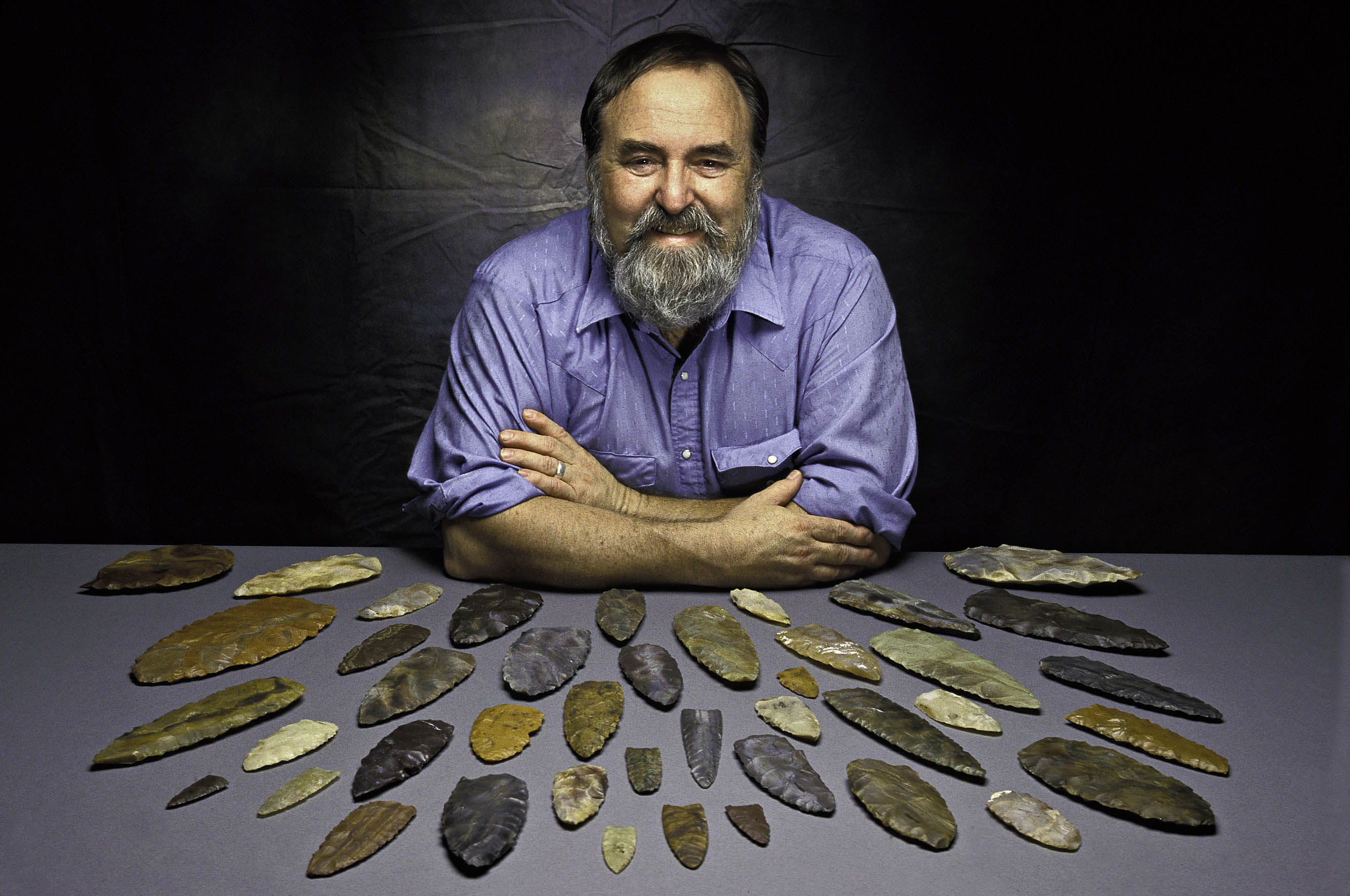
Dennis Stanford with Clovis stone points from the collection of the Smithsonian’s National Museum of Natural History. (Photo by Chip Clark)
In “Across Atlantic Ice,” the authors trace the origins of Clovis culture from the Solutrean people, who occupied northern Spain and France more than 20,000 years ago. They believe that these people went on to populate America’s east coast, eventually spreading at least as far as Venezuela in South America. The link between Clovis and contemporary Native Americans is not yet clear. Bradley and Stanford do not suggest that the people from Europe were the only ancestors of modern Native Americans. They argue that it is evident that early inhabitants also arrived from Asia, into Alaska, populating America’s western coast. Their ongoing research suggests that the early history of the continent is far more intriguing than we formerly believed. Some of the archaeological evidence analyzed in the book was recovered from deep in the ocean. When the first people arrived in America, sea levels were nearly 130 meters lower than today. The shore lines of 20,000 years ago, which hold much of the evidence left by these early people, are now under the ocean. This is also the case in Europe.

Clovis-made stone tools in the hands of Bruce Bradley, co-author of Across Atlantic Ice: The Origin of America’s Clovis Culture. (Photo by Jim Wileman)
“We now have really solid evidence that people came from Europe to the New World around 20,000 years ago,” Bradley says. “Our findings represent a paradigm shift in the way we think about America’s early history. We are challenging a very deep-seated belief in how the New World was populated. The story is more intriguing and more complicated than we ever have imagined.” “There are more alternatives than we think in archaeology and we need to have imagination and an open mind when we examine evidence to avoid being stuck in orthodoxy,” Stanford adds. “This book is the result of more than a decade’s work, but it is just the beginning of our journey.”Across Atlantic Ice is published by University California Press, Berkeley.–Source University of Exeter
Reproduced from article published in 2012 at this link
Subscribe to:
Posts (Atom)